




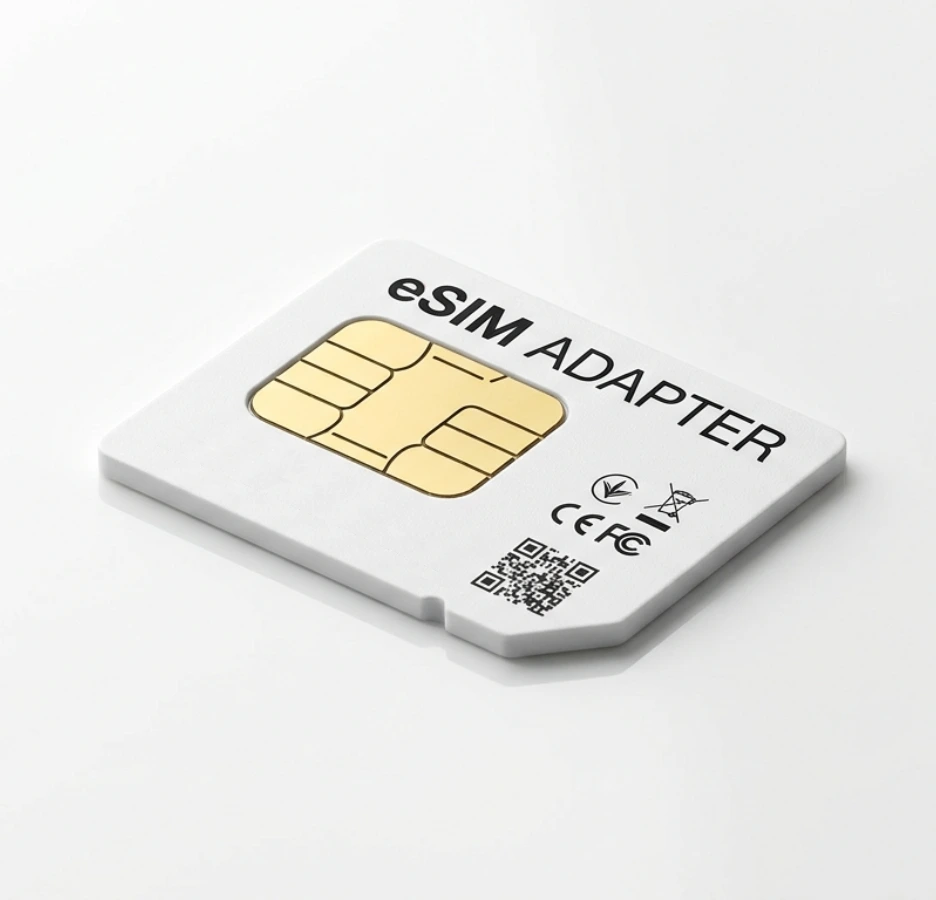
In recent years, eSIMs (digital SIM cards embedded directly into devices) have emerged as one of the more intriguing developments in mobile technology. They allow users to activate a phone number or data plan without ever inserting a physical card into a handset. Instead, everything happens through software, often as simply as scanning a QR code.
And yet, for all their evident advantages, a practical obstacle remains: not all smartphones support eSIM. That gap has given rise to a little-known device: the eSIM adapter.
What an eSIM Adapter Is (and Why It Exists)
An eSIM, or “embedded SIM,” works by moving network credentials (your number, carrier, and data plan) from a removable card onto a programmable chip built into the device. The benefits are straightforward: switching carriers without swapping hardware, managing multiple numbers on a single phone, or activating a data plan in minutes, even from abroad.
An eSIM adapter does something that sounds almost paradoxical. It takes that programmable capability and places it inside a physical SIM card. In effect, it is a “smart” SIM that behaves like an eSIM.
The result: even smartphones without native eSIM support can use eSIM profiles.
How an eSIM Adapter Works, in Practice
The process is more involved than with a built-in eSIM, but not dramatically so.
First, the adapter is inserted into the SIM slot like any standard nano-SIM.
Second, a companion app—usually provided by the manufacturer—allows users to download eSIM profiles, manage multiple numbers, and toggle lines on or off.
Third comes installation. This typically happens in one of two ways: by scanning a QR code, as with traditional eSIMs, or by installing a profile directly through a provider’s app. An internet connection is essential at this stage.
Finally, once installed, the adapter functions like a conventional SIM: signal appears, mobile data works (4G or 5G), and the line can be used for calls, texts, or data, depending on the plan.
One SIM, Many Profiles
One of the more compelling features of these adapters is their ability to store multiple eSIM profiles at once. Entry-level models may hold five profiles; more advanced versions can store ten or more, with some supporting as many as 15 to 30.
There is a caveat: typically, only one profile can be active at any given time. Switching between carriers or plans must be done through the app.
The Real Advantage: Travel
If there is a context in which eSIM adapters make immediate sense, it is travel.
They allow users to purchase a data plan before departure and activate it upon arrival, avoiding the scramble for connectivity at the airport. Costs are often lower than traditional roaming, and sometimes even cheaper than local SIM cards. There is no need for queues, paperwork, or in-person activation. And the flexibility is notable: a traveler can maintain multiple plans—local and international—and switch between them as needed.
Where They Fall Short
For all their promise, eSIM adapters are not without limitations.
Compatibility is not universal; some smartphones lack the necessary support for them to function reliably. User experiences vary: some report seamless performance, while others encounter glitches or incompatibility with certain carriers. Most adapters depend on proprietary apps, and in some cases require a USB reader connected to a computer for management.
There are also restrictions tied to licensing. Certain products limit use to a single device or charge fees to transfer the SIM to another phone.
And, in some situations, simpler alternatives (buying a local SIM card or using a budget phone with native eSIM support) may prove more practical.
Cost Considerations
Prices vary widely. Basic models typically range from €20 to €40, while more advanced versions can reach €70 to €100. Optional USB readers may add around €10. To this must be added the cost of eSIM data plans, which vary by country and provider.
Not Quite Magic, But Close
Online demonstrations often describe these adapters as “magical,” and in a sense, they are. They enable something that until recently seemed unlikely: using an eSIM on a device that was never designed to support one.
But the underlying technology is less mysterious than it appears. At its core, it remains a physical SIM—albeit one equipped with a programmable chip.
So, Is It Worth It?
The answer depends largely on the user.
eSIM adapters occupy a middle ground: part workaround, part innovation. They are neither perfect nor universal, but they address a genuine need: extending the benefits of eSIM technology to devices that lack it.
For some (frequent travelers or technology enthusiasts) they can be surprisingly useful. For others, they remain an interesting but nonessential accessory.
As with many transitional technologies, their future will hinge on one factor above all: simplicity.
They make sense if you travel frequently, own a smartphone without eSIM support and prefer not to replace it, or want the flexibility to manage multiple carriers. They make less sense if you change phones often, prefer a solution that “just works,” or can easily switch to a device with native eSIM built in.
Lyca Mobile makes it easier
The choice with Lyca Mobile is much simpler: all offers are available with either a physical SIM or an eSIM, so you don’t have to make that decision at all. Simply choose the plan you like best, select between a SIM or an eSIM, and you’re all set. While an eSIM adapter can be a very useful tool, it’s not something you’ll need when you choose Lyca Mobile.