




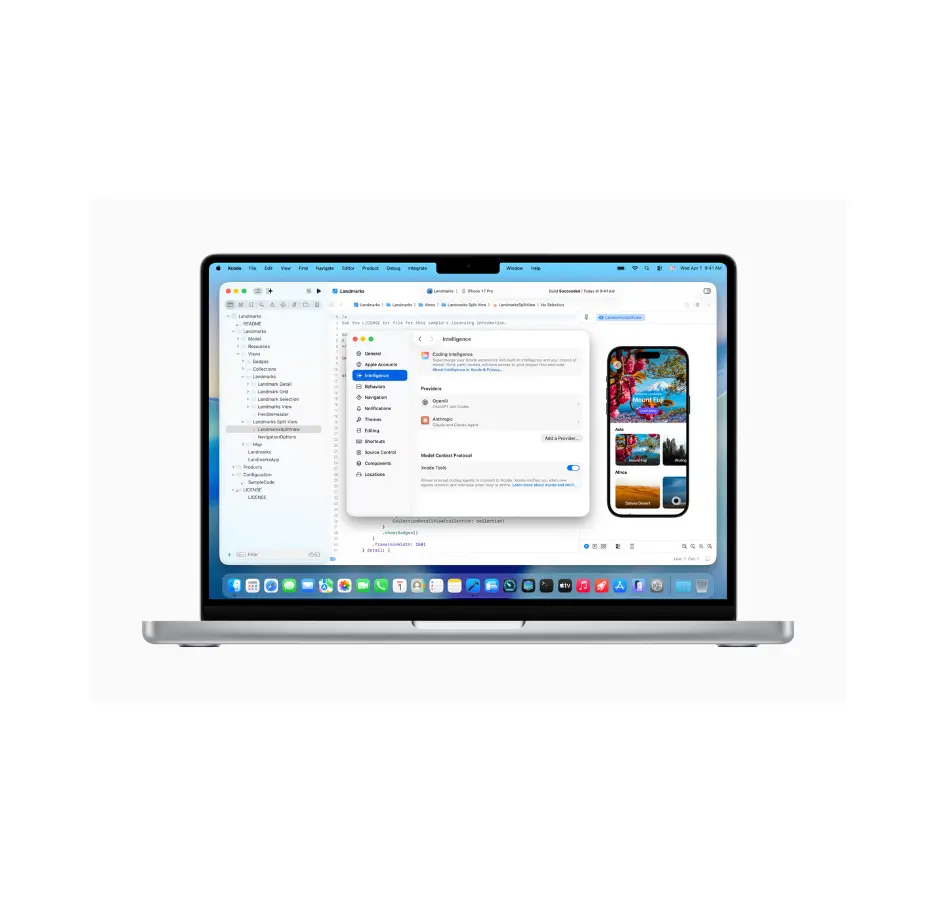
If you're in a hurry:
- Xcode 26.3 introduces “agentic coding,” letting AI agents like Claude and Codex autonomously write, test, and verify code.
- Agents can navigate project files, consult documentation, compile builds, and use visual previews to check their work.
- Apple adopts the open Model Context Protocol, allowing other compatible AI tools to integrate with Xcode.
- Developers gain speed and creativity, but experts warn of security risks and unpredictable AI-generated code.
- The update is available as a release candidate for Apple Developer Program members, with a full release soon.
Agentic Coding: AI Takes the Wheel
Apple’s flagship developer tool, Xcode, just took a bold step into the future of software creation. With Xcode 26.3, developers can now integrate AI coding agents like Anthropic’s Claude Agent and OpenAI’s Codex directly into their workflow. This “agentic coding” allows AI to autonomously handle tasks ranging from writing and debugging code to running tests and verifying app functionality—dramatically speeding up the app-building process.
Only Port-In
5G Max speed 2 Gbps
5G Portin 599
150GB in 5G Data
€5.99 /30 Days
A Deeper Integration Than Ever Before
Unlike previous versions that only offered code suggestions, Xcode 26.3 gives AI agents access to nearly every part of the development environment. Agents can analyze project file structures, consult Apple’s documentation, adjust project settings, compile builds, and visually verify their work through Xcode Previews. Developers can oversee the process with automatic checkpoints, allowing them to roll back changes if results are unsatisfactory.
Opening the Door with the Model Context Protocol
A cornerstone of this update is Apple’s adoption of the Model Context Protocol (MCP), an open standard developed by Anthropic. MCP allows any compatible AI agent—not just Claude or Codex—to interface with Xcode. This makes Xcode a hub for a new generation of AI-assisted software development, offering flexibility and choice for developers who want to experiment with different AI tools.
The Rise of “Vibe Coding”
The update comes amid a surge in “vibe coding,” a practice where developers prompt AI to generate code autonomously. Proponents point to massive productivity gains, while critics warn of security risks, buggy code, and disruptions to open-source communities. Researchers have cautioned that AI-generated software could cause “catastrophic problems” if released without careful review.
Apple’s Safety Measures and Remaining Limits
Apple hopes that deep IDE integration mitigates many risks. By allowing agents access to build systems, test suites, and visual verification tools, AI can correct errors in real time. However, limitations remain: agents cannot independently debug runtime issues, and only one agent can operate on a project at a time, though workarounds exist using multiple Xcode windows.
A Turning Point for Software Development
Xcode 26.3 is available as a release candidate for Apple Developer Program members, with a full App Store release expected soon. Developers connect their AI accounts via API keys, and the system supports any agent compatible with MCP. Apple is betting that this integration will redefine software development, making programmers faster, more creative, and better equipped to bring ideas to life—while the tech industry watches closely to see if the promise of AI-driven productivity outweighs the risks.