



Add as Preferred Source on Google
DJI is moving through one of the most intense phases in its recent history, not with a single flagship announcement, but with a layered expansion of its ecosystem. Drones, pocket cameras, and portable power solutions are increasingly being designed as parts of a single workflow rather than standalone products. At the center of this evolution sits the Osmo Pocket 4 — a device that, while visually familiar, quietly represents a significant technical shift.
Osmo Pocket 4: refinement rather than reinvention
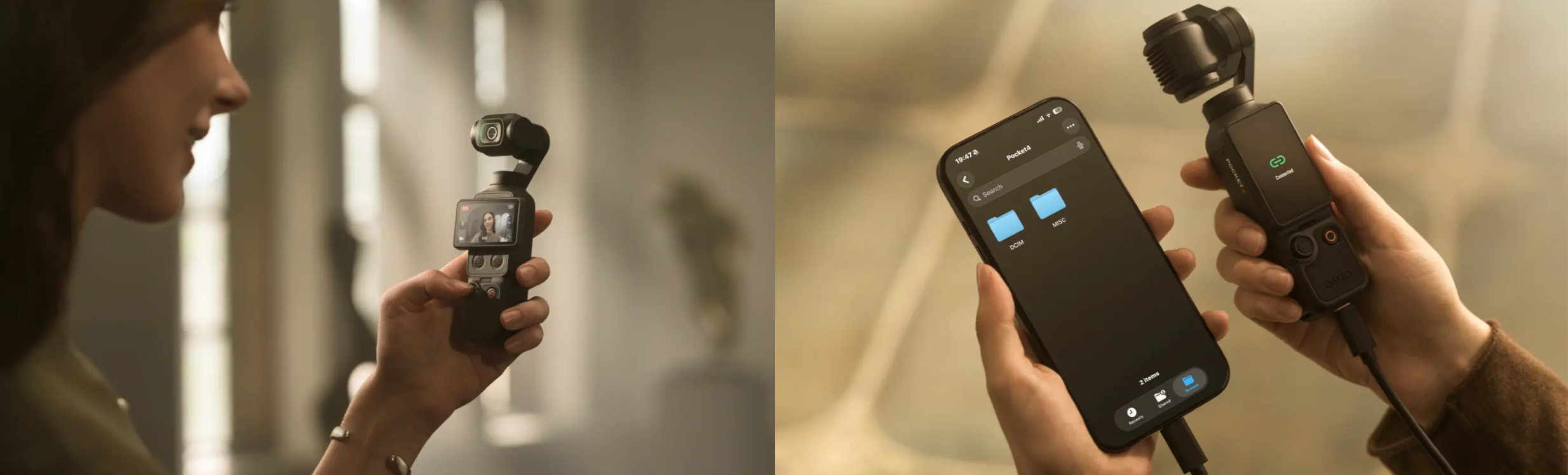
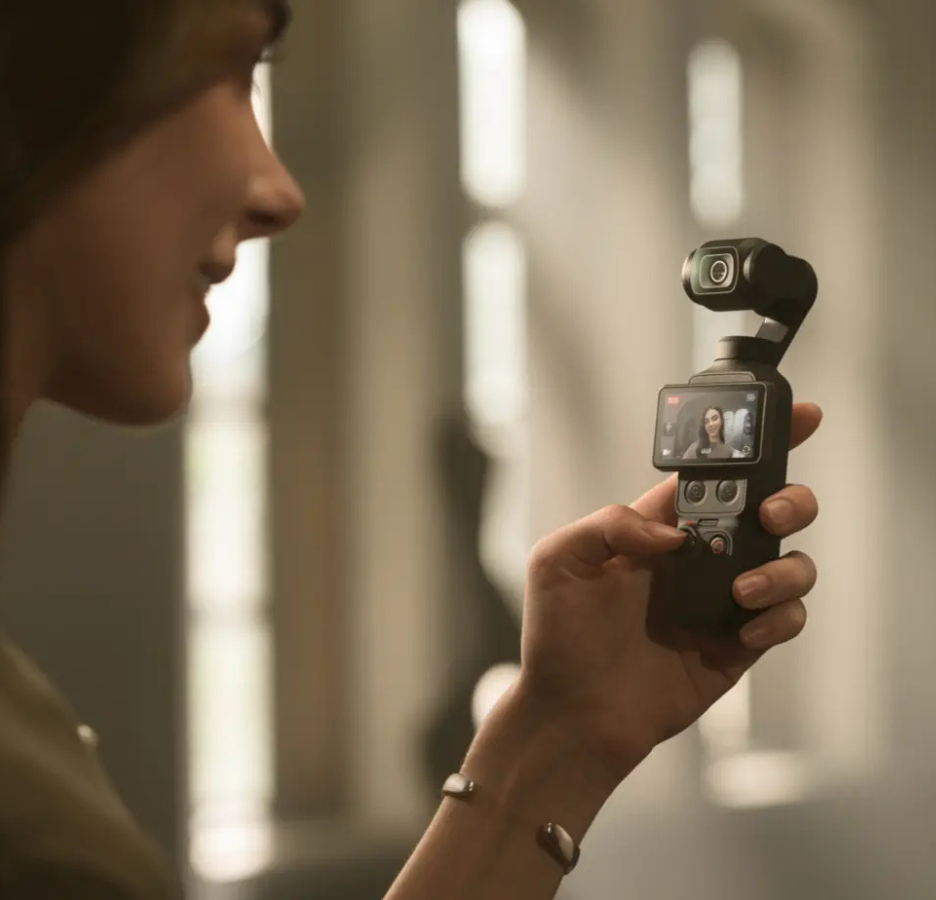
The Osmo Pocket 4 arrives after months of leaks, regulatory filings, and near-complete technical previews. On the surface, it remains what it has always been: a compact, handheld gimbal camera built around a three-axis mechanical stabilization system. Its purpose is unchanged — to deliver stabilized, high-quality video in a form factor small enough to fit in a pocket. But beneath that continuity lies a meaningful upgrade in nearly every core system.
The camera retains a 1-inch CMOS sensor with a 20mm equivalent f/2.0 lens, but image processing and performance have been significantly expanded. The most striking change is its ability to record 4K video at up to 240 frames per second, doubling the slow-motion capability of its predecessor. Combined with a claimed 14 stops of dynamic range and 10-bit D-Log color, the Pocket 4 moves closer to hybrid mirrorless territory than its compact form factor might suggest.
Still photography also receives an unexpectedly large boost. The camera can now capture images up to 37 megapixels in SuperPhoto mode, with full DNG RAW support. This marks a substantial leap from the roughly 9-megapixel output of the previous generation and subtly changes the identity of the device: it is no longer just a video tool, but a more capable hybrid imaging system.
A more deliberate approach to control and motion
One of the most practical upgrades is the rethinking of zoom and physical control. The Pocket 4 introduces a 2x lossless zoom in 4K, allowing users to tighten framing without obvious degradation in image quality, while a 4x zoom remains available in 1080p. A dedicated physical zoom button replaces the slower joystick-based workflow of earlier models, addressing one of the most persistent usability complaints from creators.
Autofocus and subject tracking have also been significantly upgraded. DJI’s new ActiveTrack 7.0 system is designed to maintain more stable recognition of people, animals, vehicles, and objects, even at higher zoom levels. It introduces smarter framing tools, including composition assistance based on rule-of-thirds and golden spiral positioning, as well as subject prioritization that allows the camera to automatically lock onto pre-registered individuals.
Gesture-based control — already common in DJI drones — has also been brought into the Pocket line. A raised palm can initiate tracking, while a simple hand gesture can start recording, reinforcing the camera’s push toward hands-free operation for solo creators.
Interface, memory, and workflow acceleration
The physical interface has been quietly but meaningfully redesigned. The 2-inch rotating OLED display remains central to the experience, but it is now brighter and supported by additional tactile controls beneath it: a more precise joystick and two configurable buttons that allow for customizable shortcuts. These changes reduce the need to navigate menus during shooting, keeping the focus on capture rather than configuration.
Perhaps more consequential is the introduction of 107GB of built-in storage. While microSD support remains, internal memory dramatically reduces setup friction, especially for spontaneous shooting. Combined with USB 3.1 transfer speeds reaching up to 800MB/s and Wi-Fi 6 connectivity, the Pocket 4 is clearly designed for faster turnaround workflows, particularly for mobile creators.
Battery life, audio, and computational creativity
Battery capacity has increased by roughly 20 percent to 1,545mAh, delivering up to four hours of recording under optimal conditions at lower resolutions. Fast charging brings the battery to 80 percent in under 20 minutes, reinforcing its role as a device meant for continuous use rather than staged production.
Audio processing has become more ambitious as well. A three-microphone array enables spatial audio capture, while an “audio zoom” feature dynamically adjusts directional focus based on optical zoom levels. While the results can be inconsistent in some scenarios, DJI compensates with tighter integration of its wireless microphone ecosystem. The Pocket 4 can record up to four audio channels simultaneously within a single file, combining internal and external sources for more flexible post-production.
On the creative side, DJI has introduced “Film Tones,” a set of six in-camera color profiles designed to simulate cinematic moods without requiring post-production grading. Alongside gesture control, live photo capture, and improved stabilization tools, the system increasingly prioritizes immediacy — reducing the gap between intent and output.
A broader ecosystem emerging around it
The Pocket 4 does not exist in isolation. Around it, DJI is building a broader and more interconnected hardware ecosystem that suggests a clear strategic direction.
A leaked prototype drone, spotted in flight testing and shared by leaker Igor Bogdanov, appears to sit between the company’s Neo and Avata lines. Compact, heavily protected, and equipped with integrated propeller guards, it is clearly designed with safety and ease of use in mind. Rather than focusing on performance or cinematic output, the design points toward accessibility — potentially as an entry-level “cinewhoop” for indoor or beginner pilots.
In parallel, a new drone family known as the “Lito” series is expected to launch on April 23, 2026. The lineup reportedly includes at least two models. The entry-level Lito 1 is positioned as a successor to DJI’s Mini-class drones, with 22GB of internal storage, around 30 minutes of flight time, and a price starting at approximately €339. Above it, the Lito X1 adds LiDAR-based obstacle avoidance, increased internal storage, and more advanced transmission systems, while remaining under the 250-gram regulatory threshold that defines much of the consumer drone market.
A teaser that points elsewhere
Adding to the speculation, DJI recently released a teaser scheduled for April 20 featuring a compact, monolithic device with a prominent LED strip and the slogan “Power beyond form.” While early rumors suggested a drone announcement, the most likely interpretation now points to a portable power station — likely the DJI Power 1000 Mini, previously released in China.
Such a product would fit neatly into DJI’s expanding ecosystem, addressing one of the most practical limitations of field-based content creation: energy supply. A compact, portable charging unit designed for drones and cameras would complete a chain that increasingly spans capture, transmission, and power management.
A system designed to remove friction
Taken together, these developments point to a coherent strategy rather than a series of isolated product launches. DJI appears to be reducing friction at every stage of content creation: simplifying capture with more intelligent cameras, expanding accessibility through safer drones, and addressing infrastructure with portable power solutions.
The Osmo Pocket 4 anchors the “ground” layer of this system, the Lito series and prototype drones define the “air” component, and the rumored power station fills in the missing piece — energy.
What emerges is not just a product lineup, but a tightly integrated ecosystem designed around a single idea: making content creation more continuous, less technical, and increasingly self-contained.