




If you’re in a hurry:
- Fitbit Air is a screenless tracker designed to reduce alerts and distractions;
- continuous monitoring of heart rate, sleep, SpO2, skin temperature and physical activity;
- weighs 5.2 grams, offers up to 7 days of battery life and fast charging;
- all health data is managed through the Google Health app;
- Gemini integration adds personalized coaching, with some advanced features reserved for the Premium subscription.
Add as Preferred Source on Google
Google has introduced Fitbit Air, a screenless fitness tracker designed for people who want to monitor their health without adding yet another display to their day.
At a moment when smartwatches have become increasingly crowded with apps, alerts and phone-like features, Fitbit Air takes almost the opposite approach. It is not meant to be checked constantly. Instead, it quietly collects biometric data throughout the day and leaves the work of displaying, organizing and interpreting that information to a smartphone.
More than a new gadget, Fitbit Air appears to be part of a broader attempt by Google to rethink its digital health ecosystem.
A tracker built to disappear
The most striking thing about Fitbit Air is also the simplest: it has no display.
The device is a small, rounded module — closer in shape to a polished pebble than to a conventional watch — designed to be worn around the clock. Without its band, it weighs just 5.2 grams; with the standard band, about 12 grams. Its dimensions are compact even by fitness-tracker standards: 34.9 millimeters long, 17 millimeters wide and 8.3 millimeters thick.
Google says it is the smallest tracker Fitbit has ever made.
The lack of a screen is not presented as a compromise but as a design decision. Fitbit Air is not trying to compete with conventional smartwatches. Its goal is to become almost unnoticeable — especially at night, during exercise or while working.
The housing is made from recycled polycarbonate and PBT plastic, and Google says the packaging is entirely plastic-free.
Designed to look less like technology
Google has also given unusual attention to appearance.
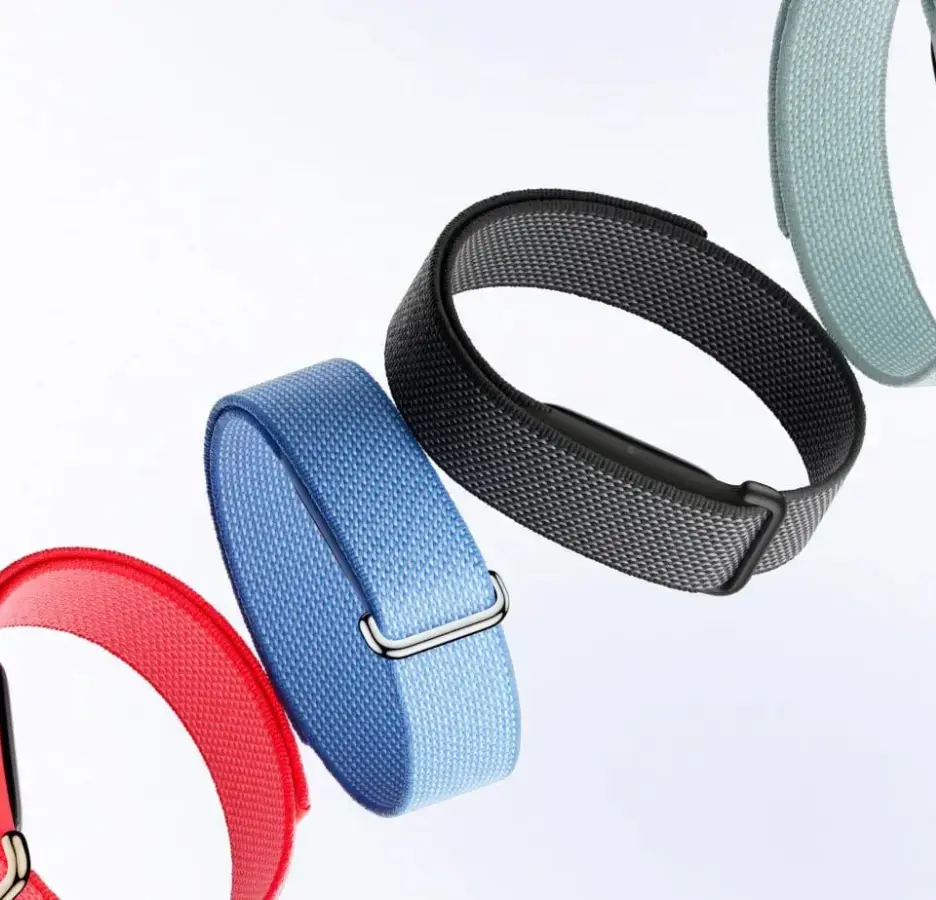
Fitbit Air comes in four colors:
- Obsidian black, with a matte black stainless-steel clasp
- Raspberry red, with a polished champagne-gold stainless-steel clasp
- Lavender purple, with a silver-gray stainless-steel clasp
- Mist gray, with a polished silver-gray stainless-steel clasp
The design language is intentional. Rather than looking overtly athletic or technical, Fitbit Air is meant to feel closer to an everyday accessory — something as suitable in an office as in a gym.
A surprisingly dense set of sensors
Its size may suggest simplicity, but Fitbit Air is equipped with a fairly extensive sensor array.
Inside the module are:
- an optical heart-rate sensor
- a three-axis accelerometer
- a gyroscope
- red and infrared sensors for blood oxygen monitoring (SpO2)
- a temperature sensor to track changes in skin temperature
- a vibration motor
Together, these allow the device to monitor continuously:
- heart rate
- heart-rate variability
- blood oxygen saturation
- sleep duration and sleep stages
- skin temperature trends
- irregular heart rhythm notifications that may indicate possible atrial fibrillation
As with other wrist-based monitors, Google notes that accuracy can vary depending on how the device is worn, the user’s physiology and the type of activity being performed.
Built for continuous tracking — even when offline
One of the more practical details concerns storage.
Fitbit Air can save:
- seven days of detailed motion data, minute by minute
- 30 days of daily totals
- heart-rate readings recorded every two seconds
That means the device is designed to keep collecting data even when it is temporarily out of sync with a phone — an important detail for a product built around continuous monitoring.
Longer battery life by doing less
The absence of a display also affects battery life.
Google says Fitbit Air can last up to seven days under typical use. It runs on a lithium-polymer battery and takes about 90 minutes to charge fully.
But the more consequential figure may be this: five minutes of charging provides enough power for an entire day.
For a tracker intended to remain on the wrist during sleep, that convenience may matter more than the headline battery number itself.
Bands, sizing and water resistance
The core module can be moved easily between different bands.
The standard woven band — included in the box — fits wrists between 130 and 210 millimeters.
The silicone version, designed more explicitly for workouts, comes in two sizes:
- Small: 130 to 175 millimeters
- Large: 165 to 210 millimeters
Fitbit Air is also water-resistant to 50 meters. Google recommends drying the band after exposure to sweat or water, both for comfort and durability.
The device is only part of the story
The larger strategy is not really about the tracker alone.
Fitbit Air arrives alongside Google Health, a broader platform that will gradually absorb much of what used to live inside the Fitbit app.
The new app — compatible with Android 11 and later and iOS 16.4 and later — becomes the center of the experience. It is where users review daily metrics, analyze sleep, follow workouts and interpret the data the tracker collects.
Synchronization happens through Bluetooth 5.0, with a range of up to nine meters, and requires Bluetooth Low Energy, internet access and location permissions on the phone.
Google’s larger ambition is to make Google Health into a central dashboard for health and wellness — one that can eventually combine information from multiple sources rather than only from Fitbit devices.
Where Gemini enters the picture
The more ambitious part of the product may lie in software.
Fitbit Air integrates with Google Health Coach, a service powered by Gemini, Google’s artificial intelligence system.
Using the tracker’s data, the system can generate:
- personalized workout plans
- recovery recommendations
- sleep summaries
- adaptive suggestions based on changing habits and progress
In simple terms, Fitbit Air measures. Gemini attempts to interpret.
That distinction matters. Collecting biometric data is no longer unusual in the wearable market. Helping users understand it — in a way that feels genuinely useful — is where Google appears to see future value.
The subscription question
Fitbit Air costs €99.99 and includes three months of Google Health Premium.
The core functions — activity tracking, heart-rate monitoring, sleep tracking and general health metrics — remain available without an ongoing fee.
More advanced features, however, sit behind the subscription:
- AI-based coaching
- deeper personalized insights
- adaptive analysis
- expanded wellness recommendations
That may become one of the more debated parts of the product. The issue is not simply cost. It is the increasingly familiar feeling of buying hardware whose full promise depends on an ongoing service.
Who it is for
Fitbit Air is aimed at a fairly specific kind of user.
It is not designed for people who want a miniature phone on their wrist.
It may appeal more to people who want to:
- monitor sleep and recovery
- reduce notifications and distractions
- wear something extremely light
- collect health data without needing to interact with the device itself
In that sense, its most natural comparison may be less with traditional smartwatches than with products like Whoop, which have long emphasized continuous tracking and a screenless experience.
A small sign of where wearables may be going
For years, wearables have mostly followed a predictable direction: larger screens, more functions, more overlap with the smartphone.
Fitbit Air suggests a different possibility.
It may not define the future of the category. But it does test a question that has quietly been building for some time: whether there is room for wearable technology that does less — and, precisely because of that, fits more easily into everyday life.
More than a new fitness tracker, Fitbit Air feels like an experiment in a different idea of personal technology: less visible, but more constant.