




Add as Preferred Source on Google
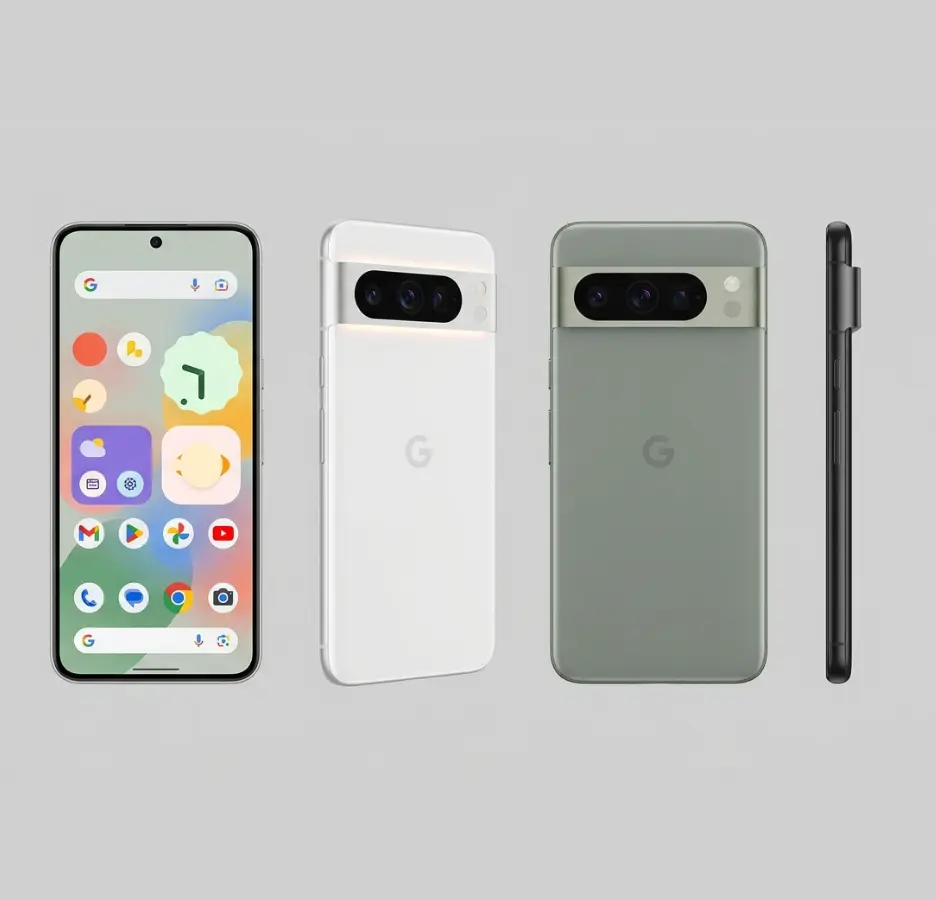
At first glance, the Pixel 11 may end up looking almost identical to the phone it replaces.
Leaks surrounding Google’s next flagship lineup point to another year of visual continuity: the same flat sides, the same horizontal camera bar, nearly identical dimensions. After the redesign introduced with the Pixel 9 generation, Google appears unwilling to radically alter the hardware again so soon.
And yet, beneath that familiar exterior, the company may be preparing one of the most ambitious shifts the Pixel line has seen in years.
The Pixel 11 is shaping up to be less about appearance and more about identity: a phone increasingly built around artificial intelligence, ambient interaction and software-driven experiences rather than raw hardware competition.
The design barely changes — and that may be intentional
The first renders of the Pixel 11 and Pixel 11 Pro suggest minimal changes compared with the Pixel 10 lineup. The devices are expected to keep the same overall proportions, the same camera bar and the same flat-edged construction introduced in recent generations.
Some details may evolve slightly. Reports mention thinner bezels and a more uniform black finish around the camera module instead of the two-tone look used previously. But overall, the industrial design appears largely frozen.
That is not necessarily unusual. Smartphone companies increasingly stretch design cycles over multiple generations, especially once a recognizable visual identity has been established. Google itself previously suggested that major aesthetic redesigns tend to happen every few years, not annually.
The more interesting question is not what Google is keeping, but what it is adding.
Pixel Glow could become Google’s most visible design experiment in years
During this year’s Google I/O conference, viewers noticed something unusual hidden inside a brief demonstration clip: a glowing light surrounding the rear camera bar of what appeared to be a Pixel prototype.
The effect immediately reignited rumors about “Pixel Glow,” a new notification system reportedly planned for the Pixel 11 lineup.
According to multiple leaks, Pixel Glow would integrate LED lighting directly around the rear camera module, allowing the phone to display visual notifications even when placed face down on a table. Different colors could correspond to different types of alerts, from calls and messages to AI-related activity.
The idea inevitably recalls the Glyph interface popularized by Nothing phones, but Google seems interested in pushing the concept toward a more ambient and functional direction rather than pure visual branding.
In practice, Pixel Glow may represent something surprisingly old-fashioned: the return of passive notifications. Before smartphones became endless streams of constantly activated displays, devices often relied on small LEDs to communicate information discreetly from a distance. Google appears ready to revive that philosophy in a more sophisticated form.
Some reports also suggest the lighting system could interact directly with Gemini AI, potentially signaling when the assistant is listening, processing or generating actions in the background.
Tensor G6 is becoming more important than the design itself
As usual, much of the Pixel story revolves around Google’s custom Tensor chip.
The upcoming Tensor G6 is expected to be manufactured using a 2-nanometer process by TSMC, a major leap in efficiency compared with previous generations. In theory, smaller manufacturing nodes allow chips to pack more transistors into the same physical space, improving both power consumption and computational performance.
Google’s challenge, however, remains the same as in previous years: performance perception.
Tensor chips have historically lagged behind Qualcomm’s Snapdragon processors and Apple’s A-series chips in raw benchmark performance, particularly in graphics-intensive tasks like gaming. Early leaks suggest that gap may not fully disappear with the G6, especially since the GPU architecture reportedly relies on older foundations.
But Google is increasingly betting that benchmarks matter less than experience.
The company’s strategy is becoming clearer with every Pixel generation: rather than competing directly on peak performance, it is building hardware optimized for AI processing, photography and contextual computing. The Tensor chip exists primarily to accelerate Gemini, image processing and machine-learning features running directly on the device.
That philosophy may become even more visible with Android 17.
Gemini is slowly turning the Pixel into an AI-native phone
The Pixel 11 lineup is expected to launch with Android 17 and deeper integration of Gemini Intelligence, Google’s evolving AI platform.
The shift is subtle but important. AI on smartphones has traditionally meant isolated features: photo editing, transcription, voice assistants. Google is trying to move beyond that model toward something more systemic.
Leaks suggest Gemini Intelligence will be capable of handling multi-step automations, dynamically generating widgets, managing contextual actions and interacting more fluidly across apps and system functions.
In other words, Google no longer wants AI to feel like an app. It wants AI to become part of the operating system itself.
That ambition explains many of the hardware decisions surrounding the Pixel 11. The Tensor G6, new TPU upgrades and changes to image processing hardware are not simply about speed. They are about creating a phone increasingly designed around continuous machine learning tasks happening in the background.
Cameras still matter — perhaps more than ever
Photography remains central to the Pixel identity, and the Pixel 11 may bring Google’s largest hardware camera update in years.
Leaks point to new 50-megapixel sensors for the standard Pixel 11 and Pixel 11 Pro Fold, while the Pro models are expected to receive upgraded main and telephoto sensors. Some reports mention a possible 64-megapixel telephoto camera designed to improve zoom quality significantly.
Google has traditionally relied more heavily on computational photography than on sensor size alone. But the company may now be reaching the limits of what software alone can compensate for. Better hardware, paired with Google’s AI-driven image processing, could finally narrow the gap between Pixel cameras and the increasingly aggressive hardware strategies of Apple, Samsung and Chinese manufacturers.
There are also rumors about advanced low-light video capabilities and the possible return of secure infrared facial recognition through under-display sensors, although those reports remain less certain.
The Pixel is becoming more “Google” than ever
For years, Pixel phones often felt like Android reference devices: clean software, excellent cameras and modest hardware ambition.
The Pixel 11 suggests Google is moving beyond that role.
The company now appears less interested in matching competitors spec for spec and more focused on building a distinctly Google interpretation of what a smartphone should be. Ambient AI, contextual interaction, passive notifications, on-device intelligence and deeply integrated software experiences are becoming more important than raw processing numbers or radical redesigns.
That approach carries obvious risks. Consumers still notice benchmarks, battery life and hardware limitations. If Tensor continues to trail rivals too visibly in performance, Google may struggle to justify flagship pricing.
But the company seems increasingly convinced that smartphones are entering a different phase — one where intelligence, automation and context matter more than industrial spectacle.
The Pixel 11 may look almost unchanged on the outside. Internally, though, it could represent the clearest version yet of Google’s long-term vision for the smartphone.