




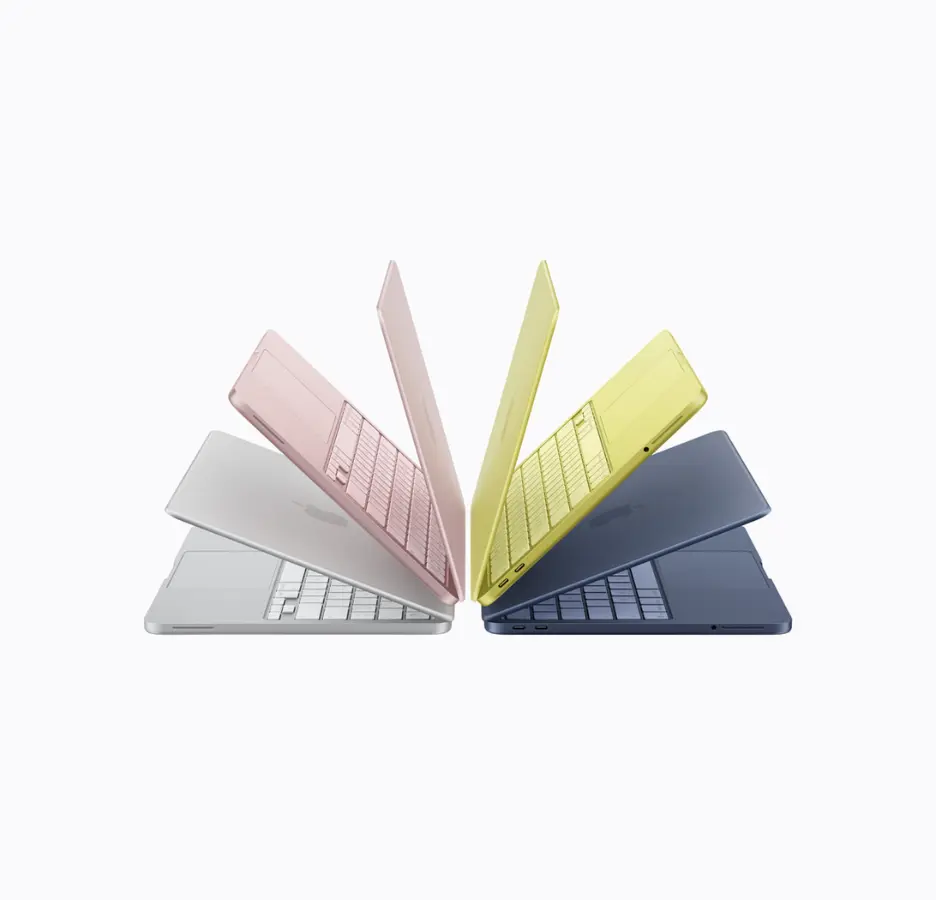
For more than a decade, the MacBook Air has served as the entry point to Apple’s lineup of laptops. Since 2011, anyone looking for a relatively affordable Mac portable device would almost inevitably end up there: the company’s lightest and most accessible computer, though still firmly positioned in the premium tier of the market.
With the introduction of the new MacBook Neo, announced on March 4, that hierarchy is changing for the first time. Not because the MacBook Air is going away, but because Apple has introduced something it had never really offered before: a laptop designed explicitly to cost much less than the rest of its lineup.
Starting at about $599 in the United States — roughly €699 in Europe — the MacBook Neo becomes the least expensive laptop Apple has ever sold. It is not simply another model in the company’s catalog. It is also a strategic experiment that could reshape how Apple approaches its computers in the years ahead.
Apple executives framed the device as an effort to expand the reach of the Mac. John Ternus, the company’s senior vice president of hardware engineering, said the laptop had been designed “from the ground up to be more affordable for even more people.” The goal, he said, was to bring what Apple calls “the magic of the Mac” to a broader audience while preserving elements the company considers essential, including an aluminum design, long battery life and deep integration with the rest of Apple’s ecosystem.
A Mac designed to cost less
To understand why the Neo matters, it helps to start with a simple fact: Apple has rarely shown much interest in the lower end of the laptop market.
For years the company focused on the mid-to-high range, where profit margins are stronger and control over the user experience is easier to maintain. Even the most affordable Mac models were still comparatively expensive next to many competing laptops.
The MacBook Neo changes that approach.
Its goal is straightforward: to lower the barrier to entry into the Mac ecosystem. The computer is built around the A18 Pro chip, a processor derived from the one used in high-end iPhones and adapted to run macOS. It is not part of the M-series Apple Silicon chips that power the rest of the Mac lineup, but it remains powerful enough for most everyday computing tasks.
In practical terms, the Neo is intended for people who use their computers to browse the web, write documents, manage email, join video calls and watch streaming content. Those tasks now make up the majority of everyday computer use and do not necessarily require particularly powerful hardware.
The base configuration includes 8 gigabytes of unified memory and 256 gigabytes of solid-state storage, with a 512-gigabyte option available at a slightly higher price.
Those specifications are modest, especially for a computer released in 2026, but they are sufficient for the type of usage the device is designed to support.
The A18 Pro chip also includes a 16-core Neural Engine designed to accelerate artificial intelligence tasks performed directly on the device, such as summarizing notes or applying advanced effects to photos. Like the MacBook Air, the Neo is also fanless, relying on passive cooling so the laptop operates completely silently during everyday use.
The inevitable comparison with the MacBook Air
The most obvious comparison is with the newly updated MacBook Air (M5), which was introduced at roughly the same time.
The MacBook Air remains the “standard” laptop in Apple’s lineup — a machine designed to last for years and handle heavier workloads such as multitasking, software development, creative work and video editing.
The differences are immediately visible in the specifications. The MacBook Air starts with 16 gigabytes of memory and 512 gigabytes of storage, runs on Apple’s new M5 chip — significantly more powerful than the processor in the Neo — and includes more advanced components across nearly every part of the system, from the display to connectivity, audio and camera.
Its port selection is also more complete. The MacBook Air supports Thunderbolt 4, includes Apple’s magnetic MagSafe charging system and can drive multiple external displays simultaneously. The Neo, by contrast, offers only two USB-C ports and omits several technologies that have become standard in the broader Mac lineup.
The difference is reflected in performance as well. Early estimates suggest that the M5 chip in the MacBook Air could deliver roughly twice the computing power of the A18 Pro processor used in the Neo.
That does not mean the Neo is slow. In many everyday scenarios, the difference may be difficult to notice. But the gap becomes clear with more demanding workloads, such as video editing, programming or running many applications at once.
In other words, the Neo is not designed to replace the MacBook Air. It is designed for a different audience.
Who it is really for
Apple has not been particularly subtle about the target market for the new laptop.
The MacBook Neo is aimed primarily at students, casual users and people whose computing needs are relatively light. It could also appeal to those who currently rely mainly on tablets or smartphones but want a device with a full keyboard and desktop operating system.
In that sense, the Neo has more in common with a Chromebook than with a traditional Mac laptop. The idea is to offer the macOS experience — along with the tight integration of Apple’s ecosystem — at a price point closer to that of the inexpensive computers that dominate the market.
According to several industry analyses, laptops priced between $500 and $1,000 account for the largest share of global sales. Until now, Apple has largely remained outside that segment.
The Neo represents the company’s first serious attempt to enter it.
The compromises required
To reach such a low price, Apple had to make several trade-offs.
The most obvious is memory. The Neo is limited to 8 gigabytes of RAM, and it cannot be expanded. For lighter use, that may be sufficient, but it becomes a limitation for people who work with heavier software or keep many applications open simultaneously.
Other hardware choices reflect the device’s position in the lineup. The keyboard is not backlit, the audio system uses two speakers instead of the four found in the MacBook Air, and the camera is a standard 1080p webcam rather than the more advanced 12-megapixel camera with smart framing features used in Apple’s higher-end laptops.
The 13-inch display remains perfectly adequate for everyday use but omits some technologies found in other MacBooks, such as support for the wider P3 color gamut or the True Tone feature that automatically adjusts color temperature based on ambient lighting.
Even so, Apple has emphasized the screen as one of the laptop’s stronger features. The 13-inch Liquid Retina display supports up to one billion colors and reaches about 500 nits of brightness — specifications that place it above many laptops in the same price range.
These details do not prevent the computer from doing its job. But they make its place in Apple’s product hierarchy quite clear.
A strategic experiment
Even with those compromises, the MacBook Neo is most interesting for what it represents.
With this model, Apple is demonstrating that macOS can run effectively on simpler hardware and on chips originally designed for smartphones. That marks a notable shift from the traditional separation between the processors used in iPhones and those used in Mac computers.
The move opens new possibilities. If a laptop can function well with an A-series chip, the same approach could potentially extend to other types of devices.
Some observers have already speculated about the possibility of a future desktop computer positioned between the Apple TV 4K and the Mac mini — a small, inexpensive Mac designed to connect directly to a monitor or television and handle tasks like web browsing, streaming and basic productivity.
Such a device could become the most affordable gateway into the macOS ecosystem.
What might come next
Interest in this new product line is not limited to the current model.
According to the Apple analyst Ming-Chi Kuo, the company may already be planning a second generation of the budget MacBook for release around 2027. Among the possibilities being discussed is the addition of a touchscreen.
For Mac laptops, that would be a significant shift. Windows laptops have included touch displays for years, but Apple has consistently kept the worlds of Mac computers and iPads separate.
Introducing touch input to the Mac would likely require broader changes to macOS, which has traditionally been designed around the use of a mouse or trackpad.
If such a change were to happen, it would be difficult to imagine it remaining limited to a single product.
Apple has also positioned the Neo as the company’s lowest-carbon MacBook to date. According to the company, the device uses about 60 percent recycled materials, including recycled aluminum in the enclosure and recycled cobalt in the battery. It is part of Apple’s broader effort to make its entire supply chain carbon neutral by 2030.
A different kind of Mac
The MacBook Neo is not Apple’s most powerful laptop, nor is it the most advanced.
But it may turn out to be one of the most important in recent years.
Not because of its technical specifications, but because of what it signals: that the Mac experience can exist on simpler, more affordable devices aimed at a much broader audience.
If the strategy succeeds, Apple may discover that there is room for a new generation of computers designed not to be the most powerful on the market, but simply the most accessible.