




If you're in a hurry:
- NVIDIA introduced DLSS 5 at GTC 2026, signaling a shift toward neural rendering in real-time graphics
- the technology moves beyond traditional Deep Learning Super Sampling, blending conventional rendering with generative AI to construct each frame
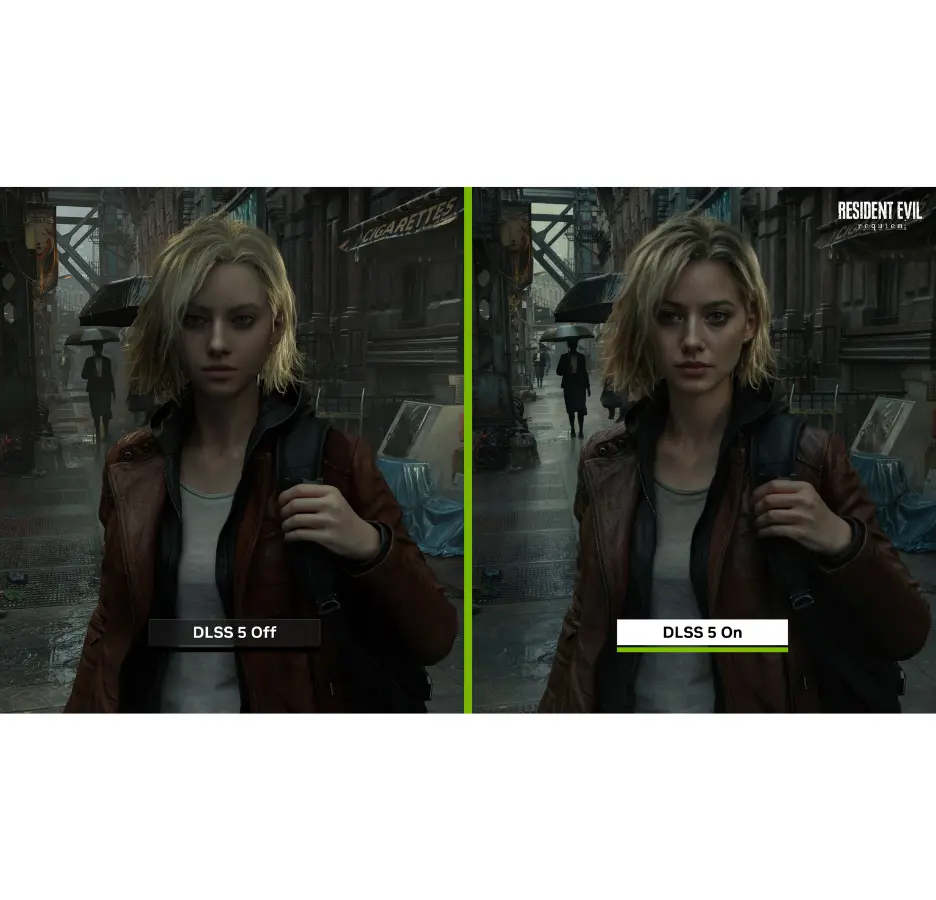
- its primary focus is photorealistic lighting, significantly improving how skin, hair and materials are rendered and integrated into scenes
- the goal is to narrow the gap between video game graphics and cinematic visual effects without requiring massive computational power
- DLSS 5 is expected this fall, initially on high-end GPUs, with early support from major studios and upcoming titles
- key questions remain about hardware requirements, real-world adoption and its impact compared to existing technologies
Only Port-In
5G Max speed 2 Gbps
5G Portin 599
150GB in 5G Data
€5.99 /30 Days
At its annual developer conference, GTC 2026, NVIDIA unveiled what it describes as its most consequential advance in computer graphics in years. The new technology, called DLSS 5, represents not just an iteration of its existing tools, but a rethinking of how digital images are produced in real time.
For much of the past decade, the company’s Deep Learning Super Sampling has been associated with performance: a way to make games run faster by rendering fewer pixels and reconstructing the rest with artificial intelligence. With DLSS 5, that definition no longer quite applies. The system is not merely optimizing images — it is actively participating in their creation.
Blurring the Line Between Rendering and Generation
At the center of DLSS 5 is a concept often referred to as neural rendering, a hybrid approach that merges traditional 3D graphics techniques with generative artificial intelligence. Instead of calculating every element of a scene from scratch, the system uses trained models to predict and reconstruct parts of the image.
According to Jensen Huang, NVIDIA’s founder and chief executive, this marks a fundamental shift. Frames are no longer strictly “rendered” or “generated.” They are both — the result of a continuous interplay between deterministic computation and probabilistic inference.
The implication is subtle but significant: some aspects of what appears on screen are no longer directly computed, but inferred by an algorithm that has learned how the world should look.
Lighting as the New Frontier
Where earlier versions of DLSS focused on resolution and frame rates, DLSS 5 turns its attention to a more elusive dimension of realism: light.
The system processes color and motion data from each frame and applies a neural model trained to understand the properties of different materials and surfaces. Skin, hair, fabric and metal are treated differently, allowing the software to generate lighting effects that respond more naturally to the scene.
In demonstrations, this has translated into more lifelike faces, with subtle subsurface scattering beneath the skin, and environments that feel more cohesive, as if objects are more convincingly anchored in space. Shadows soften and diffuse in ways that more closely resemble how light behaves in the physical world.
Closing the Gap With Cinema
For decades, real-time graphics have been constrained by time. A single frame in a video game must be produced in milliseconds; a comparable frame in a film can take minutes or even hours to render.
DLSS 5 is an attempt to bridge that divide not by brute force, but by approximation. Rather than calculating every ray of light, the system generates plausible results based on learned patterns, bringing real-time imagery closer to the visual richness of cinematic effects.
NVIDIA has framed this as a step toward film-quality graphics without the infrastructure of a Hollywood studio — an ambition that, if realized, could reshape expectations across the industry.
Promise, and Uncertainty
The early demonstrations — featuring titles such as Starfield, Hogwarts Legacy and Assassin’s Creed Shadows — have been striking, though not without caveats. Some comparisons were made against versions of games without DLSS enabled, and minor visual artifacts were still visible in certain scenarios.
The company itself has acknowledged that what has been shown is a work in progress, the product of roughly three years of development. Important questions remain unresolved, particularly around hardware requirements. The demonstrations ran on extremely powerful systems, and while NVIDIA says DLSS 5 will function on a single graphics card, it is likely to demand high-end hardware, at least initially.
Industry Support and What Comes Next
Despite these uncertainties, support from major publishers is already in place. Companies such as Bethesda, Capcom and Ubisoft are expected to adopt the technology in upcoming releases.
DLSS 5 is scheduled to arrive this fall, though a precise timeline has not been announced. Its long-term impact will depend not only on its technical capabilities, but on how widely it can be deployed — and whether developers and players alike embrace a future in which parts of every image are, in a sense, imagined.
For now, DLSS 5 stands as both a technological milestone and an open question: a glimpse of a possible future for computer graphics, still waiting to be tested outside the controlled environment of a conference stage.
FAQ about NVIDIA DLSS 5
What is DLSS 5?
DLSS 5 is the latest evolution of Deep Learning Super Sampling by NVIDIA, using artificial intelligence not just to enhance performance but to actively help generate the final image.
How is it different from previous versions?
Unlike earlier iterations, DLSS 5 goes beyond upscaling and frame generation by introducing neural rendering — blending traditional graphics with generative AI to build each frame.
What does it improve in practice?
Its main impact is on lighting and materials: characters and environments appear more realistic, with more natural light interaction and shading.
Does DLSS 5 make games truly photorealistic?
It can get significantly closer to photorealism, but results will vary depending on hardware capabilities and how developers implement the technology.
When DLSS 5 will be available?
DLSS 5 is expected to launch in the fall, following its reveal at GTC 2026.
What hardware will support it?
It will likely require high-end GPUs, starting with the RTX 50 series. Exact requirements have not yet been fully detailed.
Which games will support DLSS 5?
Early confirmed titles include Starfield, Hogwarts Legacy and Assassin’s Creed Shadows, along with several other major upcoming games.
Will DLSS 5 replace traditional rendering?
Not entirely. Instead, it complements it by combining conventional rendering techniques with AI-driven image generation.