




Add as Preferred Source on Google
When Valve finally revealed the price of its long-rumored Steam Machine, the reaction was immediate. The base model starts at $1,049 without a controller, while the highest-end configuration exceeds $1,400. For a device that occupies roughly the same space beneath a television as a PlayStation 5, and often delivers similar gaming performance, those numbers seemed almost deliberately provocative.
It would be easy to conclude that Valve simply misjudged the market. But the Steam Machine's price tells a much larger story than the fate of a single piece of hardware. It offers an unusually clear window into a structural shift that is reshaping the economics of consumer technology, and one that the gaming industry may only be beginning to confront.
Valve never intended the Steam Machine to cost this much.
Engineers Pierre-Loup Griffais and Yazan Aldehayyat have acknowledged that the company originally envisioned a machine closer to the $700 range. In another market, that would have positioned it as an expensive but plausible alternative to traditional consoles. Instead, an extraordinary surge in component costs forced Valve to abandon those ambitions long before the product reached consumers.
The culprit is memory.
For decades, DRAM and NAND flash quietly became cheaper, denser, and more abundant. That expectation has now broken down. Manufacturers such as Samsung, SK Hynix, and Micron increasingly prioritize hyperscale AI companies that purchase enormous volumes months or even years in advance to build data centers. Compared with customers like Nvidia, Microsoft, Google, or OpenAI, companies making gaming hardware represent a far smaller business opportunity.
Griffais described the resulting supply chain with unusual bluntness. Memory vendors, he said, effectively offer buyers a monthly price and an available quantity. Accept it or decline it. There are no long-term guarantees, no meaningful negotiations, and little certainty about future supply.
Those constraints ripple all the way down to the finished product. Some Steam Machines will ship with a single 16GB memory module, others with two 8GB modules, depending entirely on what happens to be available during manufacturing. Valve says its testing found no measurable performance difference between the two configurations. Even so, it is an illustration of how shortages no longer influence only prices; they now shape engineering decisions as well.
That is why Valve insists the Steam Machine's price is not a matter of strategy. The company says it has no interest in keeping hardware expensive and would gladly lower prices if component costs returned to normal. At the same time, its engineers appear unconvinced that such a reversal is likely anytime soon.
The Steam Machine therefore arrives at an unusual moment, when building a gaming PC has become dramatically more expensive than many consumers remember. In that sense, the device may be less an outlier than an early example of what gaming hardware increasingly looks like.
Ironically, the conversation around pricing has overshadowed the machine itself.
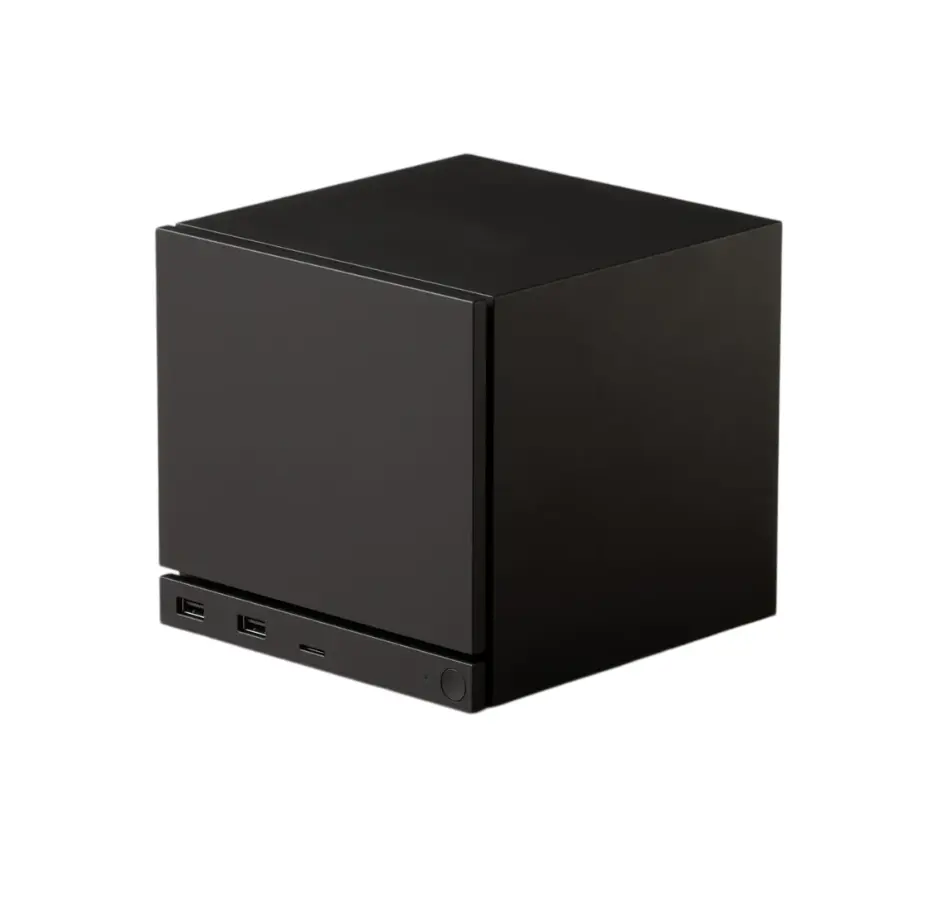
Physically, the Steam Machine is an impressive piece of engineering. It compresses a custom AMD Zen 4 processor, a semi-custom RDNA 3 GPU, up to 2TB of NVMe storage, and a sophisticated cooling system into a cube measuring just over six inches on each side. Valve claims it delivers roughly six times the performance of the Steam Deck while remaining remarkably quiet under load.
Independent reviews paint a more nuanced picture. The hardware generally performs in the same neighborhood as a standard PlayStation 5, though Sony's console often maintains a modest frame-rate advantage in demanding games despite costing hundreds of dollars less.
Valve has quietly adjusted its own marketing to reflect those realities.
Early product pages advertised "4K gaming at 60 FPS with FSR." More recently, that promise has become "up to 4K gaming with FSR 4.1." The revision is subtle but telling. The guaranteed frame rate has disappeared, replaced by language that better matches real-world testing.
The distinction matters because the advertised 4K output depends heavily on AMD's FidelityFX Super Resolution, which reconstructs a higher-resolution image from a lower rendering resolution. And even that technology is not yet fully available on the Steam Machine. Valve says it is working with AMD to bring FSR 4 to SteamOS, but has offered neither a release date nor detailed implementation plans.
None of this has prevented a surprising number of enthusiasts from defending the device.
Across Reddit and other enthusiast communities, many users have argued that discussions centered solely on frame rates miss the point. They describe the Steam Machine less as a bargain gaming PC than as an unusually elegant exercise in systems engineering: a remarkably compact, nearly silent computer designed to deliver a console-like experience without the compromises typically associated with small-form-factor PCs.
Not everyone agrees with that assessment. Critics point out that equally expensive desktop computers can deliver substantially more performance. But even skeptics often acknowledge that fitting this level of hardware into such a small enclosure while maintaining low noise levels is no trivial accomplishment.
Valve itself appears to view the Steam Machine as something larger than a single hardware product.
With SteamOS 3.8, the company has officially embraced the idea that users should be able to build their own Steam Machine by installing SteamOS on compatible desktop hardware. Today that experience works primarily with AMD systems, while broader Nvidia support remains under development. The long-term ambition is evident: SteamOS is gradually evolving from the operating system of one device into a platform that could power many different living-room gaming PCs.
That strategy may ultimately prove more significant than the Steam Machine itself.
Most analysts expect the hardware to remain a niche product. Supply constraints will limit availability, while the price effectively confines the audience to enthusiasts willing to pay a premium for a specialized experience. Valve may be perfectly comfortable with that outcome. Like the Steam Deck before it, the company's hardware exists primarily to strengthen its software ecosystem rather than generate substantial profits on its own.
Viewed from that perspective, the Steam Machine is less important as a commercial product than as a signal.
For years, the gaming industry benefited from a simple assumption: each new generation of hardware would become more capable while remaining broadly affordable. That assumption now looks increasingly fragile. If AI infrastructure continues absorbing the world's supply of advanced memory and storage, expensive gaming hardware may become the rule rather than the exception.
Whether Sony and Microsoft can avoid crossing the symbolic $1,000 threshold for their next-generation consoles remains uncertain. Their larger scale and greater ability to subsidize hardware may allow them to hold the line longer than Valve can. But even industry analysts who expect future consoles to remain below four figures acknowledge that the floor is rising quickly.
The Steam Machine, then, is not merely an expensive console. It is perhaps the first mainstream gaming device whose price has been decisively shaped by an economy increasingly organized around artificial intelligence rather than entertainment.
The most consequential thing about Valve's new hardware may not be what it can run. It may be what it reveals about where the industry is headed.